Molar Absorbance Coefficient
Where a is the Absorbance e is the Molar absorption coefficient l is the Path Length and c is the Concentration. Aabsorbance εm molar extinction coefficient C concentration lpath length of 1 cm You should have a data set which was used to create a standard curve.
1
Determining The Molar Extinction Coefficient Of Erythrosin B Io Rodeo Inc


Linear Absorption And Molar Extinction Coefficients In Direct Semiconductor Quantum Dots The Journal Of Physical Chemistry C
Examining the mathematical form of the Beer-Lambert Law the molar extinction coefficient or molar absorptivity is a constant for a given transition metal ion and the path length l is a constant as long as the same test tube or cuvette is used to make each absorbance measurement.

Molar absorbance coefficient. The molar absorptivity is a Beer-Lambert absorption coefficient. Molar and mass extinction coefficients are listed below. The concentration is simply the moles L -1 M of the sample dissolved in the solution and the length is the length of the cuvette used for the absorbance measurement and is typically 1 cm.
Understand the Beer-Lambert law for absorbance A ɛ x l x c. For many years after I first was confronted with them I lived in a kind of schizophrenic state in which I thought both concepts ie. This is most often done by measuring the ab- sorbance A near 280 nm and using the Beer-Lambert law.
The following equation can be used to calculate a molar extinction coefficient. ε molar is the molar extinction coefficient or molar absorptivity of the protein expressed as M1 cm1 ε 1 is the mass extinction coefficient or the percent solution extinction coefficient absorbance values at 280 nm for a. A IC 1 where E is the molar absorption coefficient M cm-I I is the.
While working in concentration units of molarity the Beers law is written as aecl. ε has units of L. The studies reported here suggest that the Edelhoch method is the best method for measuring epsilon for a protein.
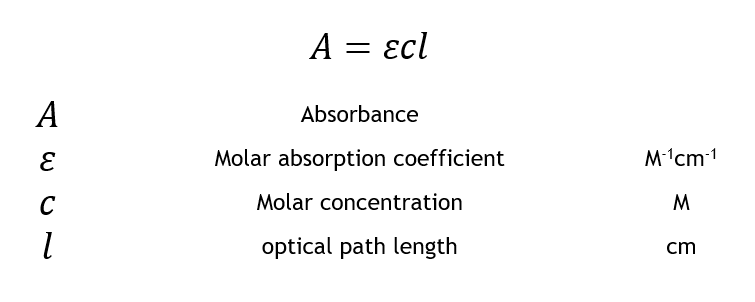
The standard equation for absorbance is A ɛ x l x c where A is the amount of light absorbed by the sample for a given wavelength ɛ is the molar absorptivity l is the distance that the light travels through the solution and c is the concentration of the absorbing species per unit volume. The graph should plot concentration independent variable on the x-axis and absorption dependent variable on the y axis. It is the linear relationship between absorbance and concentration of an absorbing species.
Calculate the molar extinction coefficient Finally using the Beer-Lambert law calculate the absorptivity constant and molar extinction coefficient from the slope of the A280 curve and the molecular weight of the protein. A is the absorbance. Where E is the extinction coefficient.
ε A 10 cl. Steps Calculating Molar Absorptivity with the Equation. Thus the molar extinction coefficient can be obtained by calculating the slope of the absorbance vs.
Estimating of the molar exctinction coefficient. Tyrosine absorbance Biochemists must frequently determine the concentration of a protein solution. Mc is the molar concentration.
Therefore a solution of 1 µgµl oligonucleotides with a path length of 1. 1 implies it holds for every spectral point but molar attenuation coefficients are often given only for the peak frequency or wavenumber of a band and not in a frequencydependent form. As an example the molar extinction coefficient for oligonucleotides is 324 µlcm-1µg-1.
A Absorptivity coefficient Absorptivity coefficient also known as the molar absorptivity coefficient is a measure of how well a chemical species chemically identical molecules absorbs a given wavelength of light. E A mc. The SI unit of molar attenuation coefficient is the square metre per mole m 2 mol but in practice quantities are usually expressed in terms of M 1 cm 1 or Lmol 1 cm 1 the latter two units are both.
The extinction coefficient is the absorbance divided by the concentration and the pathlength according to Beers Law. Abs a 1 b 1 C 1 a 2 b 2 C 2. Molar 10 ε.
According to the Beer Lambert Law the Absorbance is proportional to the path length distance that light travels through the material and the concentration of the material. Absorbance on the y-axis and concentration on the x-axis. Extinction Coefficient Formula.
A graph of Absorbance vs Wavelength for a red dye shows a maximum at 525 nm. The molar absorption coefficient is a sample dependent property and is a measure of how strong an absorber the sample is at a particular wavelength of light. Now derive a linear curve from the absorbance as a function of the concentration see example at the top of this page.
Molar and percent extinction coefficient ε. ε is the wavelength-dependent molar absorbtivity coefficient and it is constant for a particular substance. The molar absorption coefficient epsilon of a protein is usually based on concentrations measured by dry weight nitrogen or amino acid analysis.
Molar absorptivity Synonym. The constant a is called the extinction coefficient or the molar absorbtivity coefficient. Decadic absorbance divided by the path-length l and mole concentration c of the absorbing material.
Understand the Beer-Lambert law for absorbance A ɛlcThe standard equation for absorbance is A ɛlc where A is the amount of light absorbed by the sample for a given wavelength ɛ is the molar absorptivity l is the distance that the light travels through the solution and c is the concentration of the absorbing species per unit. According to Beers law A εbc where A is the absorbance ε is the molar extinction coefficient b is the path length of the cuvette and c is the concentration. The molar absorption coefficient is related to the absorption cross section σ via Avogadros constant N AIf the units of the molar absorption coefficient are taken to be L mol-1 cm-1 and the units of the absorption cross section are in cm2 then σ 1000ln10 x εN A or 382 x 10-21 x εThe absorption cross section is related to the probability of an absorption process in a solution.
It is the absorbance of a substance placed in 1cm cuvette cell when the concentration is 1 molar. The relationship between molar extinction coefficient ε. In chemistry the most commonly used unit for molarity is the number of moles per liter having the unit symbol molL or moldm 3 in SI unit.
This method is described by Gill an. Percent molecular weight of protein Still other sources provide protein absorbance values for 01 mgmL solutions as this unit of measure is more. The extinction coefficient is defined as the ratio of absorbance to the molar concentration of a.
The proportionality constant of the equation is termed as the molar extinction coefficient of the substance. Percent is as follows. A wellknown limitation of Beers law is that monochromatic light must be used since as eqn.
Molar concentration also called molarity amount concentration or substance concentration is a measure of the concentration of a chemical species in particular of a solute in a solution in terms of amount of substance per unit volume of solution. Absorbance is directly proportional to concentration and length. If there are several absorbing materials present the effects are additive.
Where ϵ v is the molar attenuation coefficient c is the concentration and d is the sample thickness. For a blue dye the maximum occurs near 625 nm. Absorbance molar absorption coefficient absorption cross.
Molar decadic absorption coefficient. The molar attenuation coefficient is a measurement of how strongly a chemical species attenuates light at a given wavelengthIt is an intrinsic property of the species. Calculate Absorbance using Beers Law.

How To Find Molar Absorptivity Using The Beer Lambert Law Chemistry Study Com
Micromeritics Com

User Moira M Esson Notebook Chem 571 2013 09 04 Openwetware

How To Calculate Molar Absorptivity 8 Steps With Pictures

Estimation Of The Molar Absorption Coefficient Of Copper Salicylate Within The Spectral Range 300 350 Nm Sciencedirect
Beer Lambert Law Transmittance Absorbance Edinburgh Instruments

Public Lab Molar Absorptivity Coefficient Of Enzyme Substrate Complex In Pesticide Detection Assay
Molar Absorption Coefficients At 278 Nm For Rnase Ti And Six Mutants Download Scientific Diagram


Comments
Post a Comment